Mother's Day & Father's Day Gifts From Kids: Best Ideas
There's something quietly moving about a gift made by little hands. A wobbly drawing, a dandelion picked from the backyard, a book your child proudly points to: it's rarely the expensive things that stay with us, but the gestures that say "I was thinking about you." Mother's Day and Father's Day fall in spring and early summer in most English-speaking countries, and it's exactly around this time that parents start hunting for something that feels genuinely personal.
Developmental psychologists have found that children who learn to give, not just receive, build a stronger sense of empathy and self-worth. The process of making or choosing something for another person is at least as valuable as the gift itself. Below you'll find gift ideas by age, practical ways to prepare them together with your child, and simple tricks to turn the moment into a lasting memory.
Why personal gifts mean more
Ask a grown-up which brand of chocolate they got last Mother's Day and they'll shrug. What we do remember is the moment: the small face that got up early, the hands hidden behind a back, the impatient "can you look now?" Psychologists call this the difference between material and experiential value. Gifts tied to an experience or a relationship deliver more lasting happiness than possessions do.
For children, there's an extra layer. When a child makes or picks something themselves, they practice real skills: planning ahead, being patient, and paying attention to what someone else might like. Maria Montessori emphasized that children grow through meaningful engagement with real tasks. Preparing a gift is exactly that kind of task, with a purpose, a recipient, and a deadline.
The most important tip for helping parents: don't let the gift be perfect. The value lives in the imperfection. A drawing that colors outside the lines is far more authentic than something a grown-up quietly "fixed." Resist the urge to take over, and you'll end up with something that actually came from your child.
Gift ideas by age
What a child can contribute depends heavily on their age. The ideas below match each developmental stage, so your child is truly involved rather than watching you do the work.
Ages 0-2: tiny hands, big impact
- A handprint or footprint keepsake. Press a little hand or foot into air-dry clay or non-toxic paint on sturdy paper. Pick a day when your baby is well-rested, because a fussy toddler and wet paint are a recipe for chaos. Write the date on the back; a decade from now it'll be pure gold.
- A photo collage of the past year. Babies can't assemble this themselves, of course, but the other parent or a grandparent can pull together a selection of moments with the parent being celebrated.
- A "first words" recording. Quietly capture the moment your little one says "mama" or "dada." That short clip becomes priceless as the years go by.
Ages 3-5: proud little makers
Preschoolers are desperate to do things themselves and burst with pride over the result. They're just starting to grasp the idea of a surprise, even if keeping a secret usually fails within minutes.
- A homemade card with a dictated message. Your child draws, and you write down whatever they want to say. Ask: "What do you love most about Daddy?" The answers are disarming and wonderfully honest.
- A "breakfast in bed" coupon. Have your child draw the breakfast they want to make together, then help with the real cooking on the day itself.
- Planting a seedling together. Sowing a seed teaches patience and care, and the parent ends up with something living that keeps growing.
Ages 6-10: independent and creative
School-age kids can read, write, and stick with a project longer. They understand humor, can compose a letter, and often have strong opinions about what counts as fun.
- A handwritten letter or poem. Offer a few sentence starters like "I love you because..." and "The funniest moment with you was..." Structure helps children who don't know where to begin.
- A "reasons I love you" jar. Fill a jar with small notes, each holding one reason. The parent can pull out one a day.
- A coupon book of deeds. Think "one round of setting the table without complaining" or "a hug whenever you want one." It's a gift of themselves rather than a store-bought item.
If you'd like inspiration matched to your child's exact age, browse our age-by-age gift pages covering everything from babies to teens.
Making a gift together, step by step
The best part of a handmade gift is the time you spend on it side by side. Here's a simple approach that works for almost any age.
- Choose the recipient and the feeling. Ask your child: "What do you want Mom to feel when she opens it?" That gives the gift direction before you pick up a single crayon.
- Limit the options. Too much choice paralyzes young children. Offer two or three ideas and let your child decide between them.
- Gather materials in advance. Nothing kills the momentum like discovering halfway through that the glue is dry. Lay out paper, markers, and tape ahead of time.
- Let your child do the real work. Fight the instinct to "improve" things. Your job is to guide, not to take over.
- Wrap it together. Wrapping is part of the fun and builds anticipation toward the big day.
A familiar trap: parents who help so much that the gift becomes mostly theirs. Children sense this instantly. The pride in their eyes when something is truly their own is worth every bit of the mess on the kitchen table.
A personalized book as a lasting gift
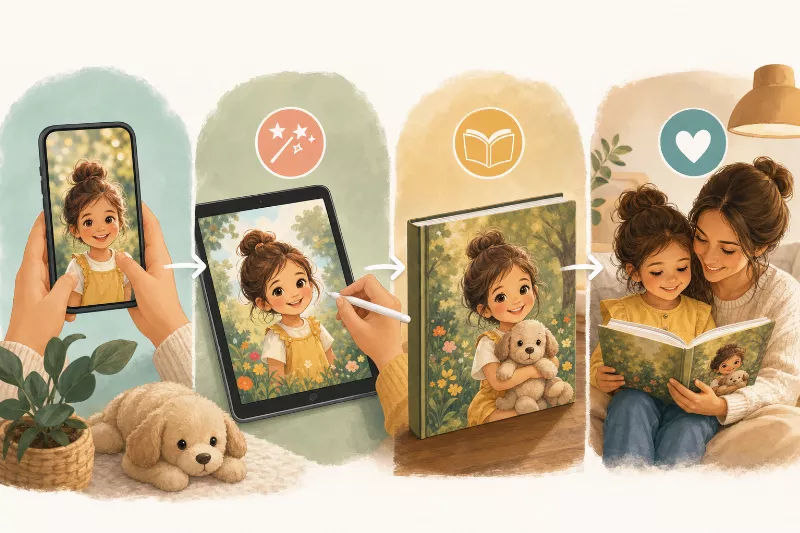
Some gifts wilt or wander off. A book stays. More and more parents are choosing a personalized children's book in which the child and the parent share the starring roles. It combines two things kids adore: hearing a story and recognizing themselves in it.
Read-aloud research consistently shows that reading together strengthens the parent-child bond and boosts language development. A book where your child is the hero on an adventure with Mom or Dad tends to get requested again and again. That turns a Mother's Day or Father's Day gift into a recurring ritual instead of a one-off moment.
What makes this kind of gift appealing for busy parents: your child is involved in the creation (choosing the name, the appearance, sometimes the storyline) without a mountain of craft supplies. Feel free to look through a few examples of personalized books to get a sense of it, or read what other parents say on our reviews page. When you're ready to make one, you can start easily on the create-a-book page.
Making the day itself unforgettable
A gift gains its glow from how you shape the day around it. It doesn't need to be grand; it's about attention and ritual.
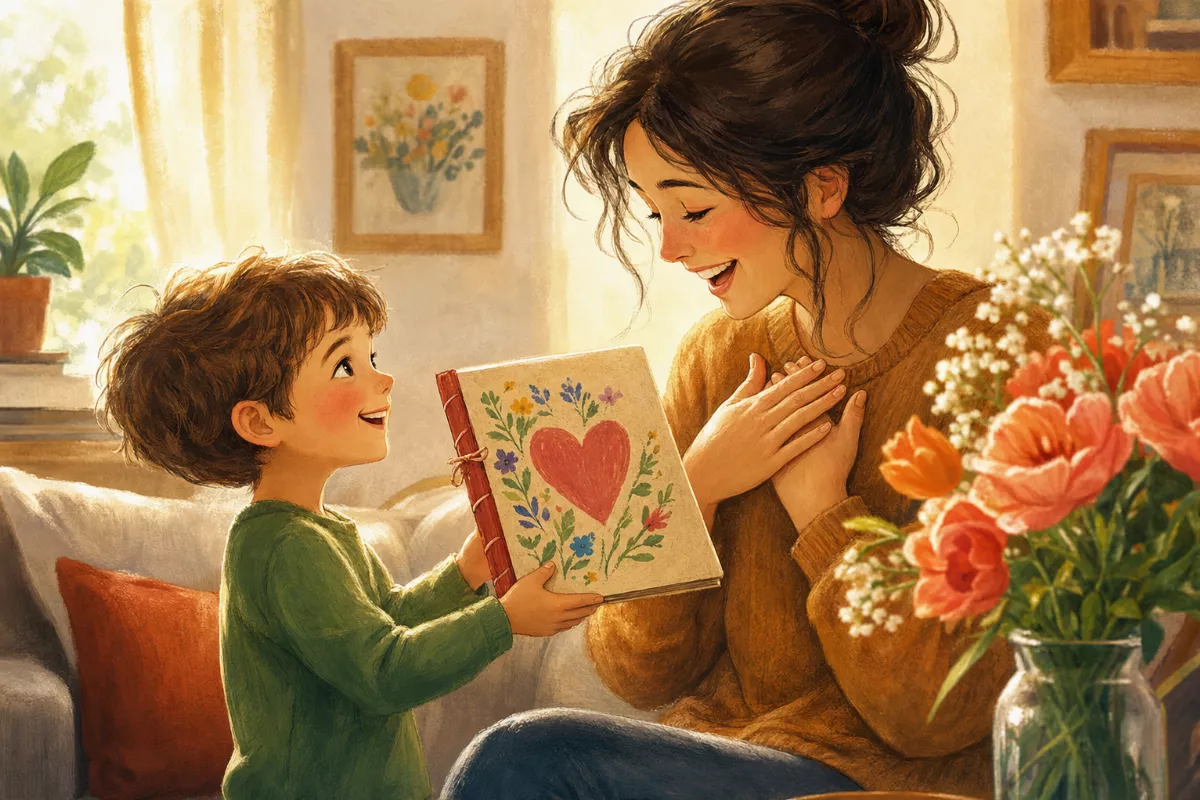
- Create a small moment of reveal. Let your child hand over the gift during a calm stretch, not in the middle of the morning rush. Put your phone away and look your child in the eye.
- React honestly and in detail. Don't just say "how lovely," name specifics: "Look, you drew my hair all curly!" Children light up at concrete appreciation.
- Turn it into a tradition. Kids thrive on repetition. The same special breakfast, the same walk, or a new book every year gives them something to look forward to and builds memories.
- Keep the gifts. Start a box or folder where you save the drawings and notes each year. By the time your child turns eighteen, you'll have a treasure trove of memories.
For extra inspiration tied to specific occasions, explore our collection of gift occasions, with ideas you can put to use right away.
It's the thought, not the price tag
Whether you go for a clay handprint, a handwritten letter, or a personalized book, the heart of it stays the same: the gift tells your child that giving feels good and that they matter. That lesson stays with a child far longer than any product ever could. Start small, let your child take part, and above all enjoy the process. The most beautiful Mother's Day and Father's Day gifts aren't found in a store; they take shape at the kitchen table.
Last updated on
18-07-2026