Your Pet's Unique Story in Its Very Own Book
- Why Your Pet Makes Such a Great Story Hero
- Deciding What Story to Tell
- Personalized Books Versus a DIY Scrapbook
- Making It Work at Every Age
- Babies and toddlers (0 to 2 years)
- Preschoolers (3 to 5 years)
- Early readers (6 to 8 years)
- The Perfect Gift for Real Occasions
- Tips for a Book Your Family Will Actually Treasure
There's a moment every pet owner knows well. Your dog flops dramatically across the doorway with a sigh worthy of a Shakespearean tragedy, and your six-year-old announces, completely seriously, "Rex is sad because he wanted to be a knight today." And just like that, your ordinary Tuesday afternoon has a plot. Pets are natural storytellers, or rather, they invite the stories we build around them. Capturing those stories in a book of their own is one of the most heartfelt keepsakes a family can make.
Why Your Pet Makes Such a Great Story Hero
Animals occupy a special place in a child's imagination. Long before children fully grasp the difference between fiction and reality, they treat pets as full characters with feelings, motives, and secret adventures. Developmental psychologist Jean Piaget described this tendency as "animism," the young child's instinct to attribute intentions and inner lives to the world around them. A cat isn't just sleeping in the sun. She's guarding the castle. A goldfish isn't circling the bowl. He's on a daring undersea patrol.
This is exactly why pets work so beautifully as book characters. Your child already believes in the story. When a book puts their real dog or cat at the center of an adventure, it validates the imaginative world they've been building all along. Research on children and animals also shows that pets support emotional development. Studies published in journals like Developmental Psychology have linked strong pet bonds with higher empathy and better emotional regulation in children. A book celebrating that bond reinforces something already valuable.
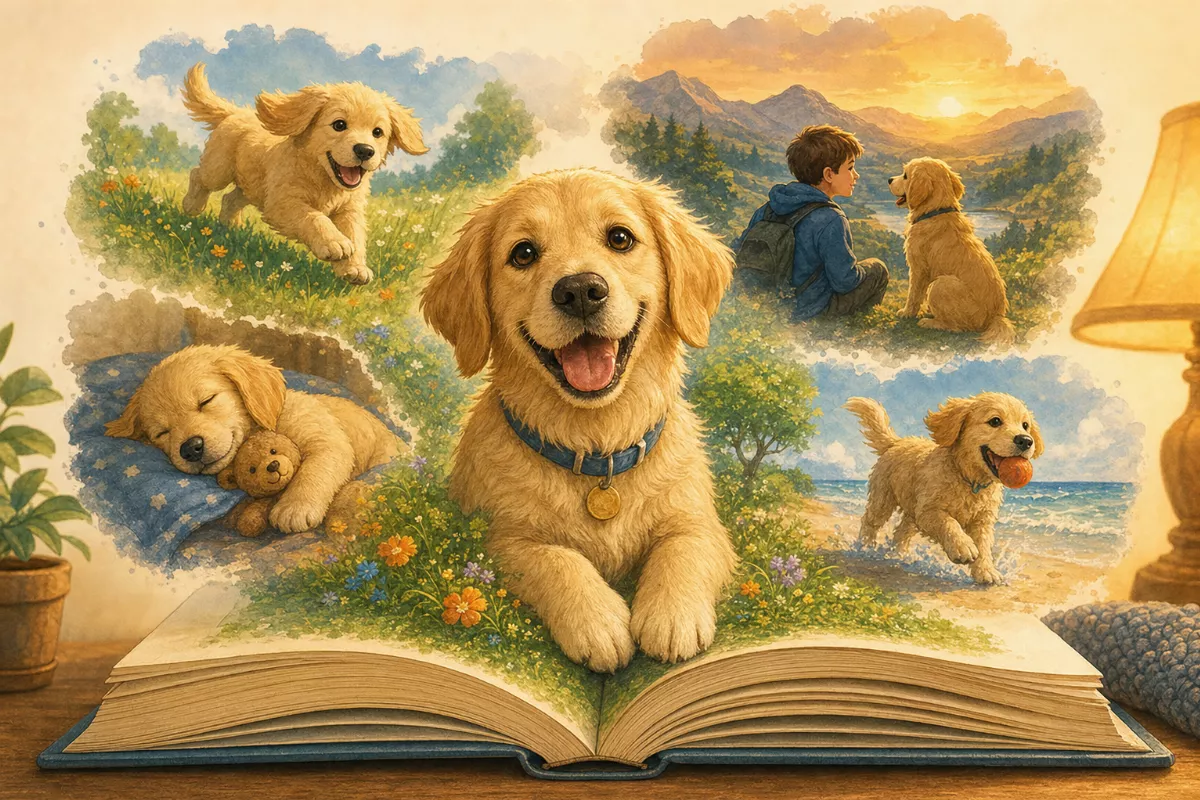
Beyond the psychology, there's the plain joy of recognition. Seeing a familiar face, floppy ears, a crooked tail, a particular coat color, printed on a glossy page turns reading from a passive activity into a delighted "That's OUR Bella!" moment.
Deciding What Story to Tell
Before you make anything, spend ten minutes thinking about the story you actually want to preserve. Pets carry a surprising number of narrative threads, and the best books lean into one clear idea rather than trying to capture everything at once.
- The origin story. How your pet joined the family is often the most emotional thread. The shelter visit, the tiny kitten who wouldn't stop meowing, the moment your child first held the leash. Kids adore hearing how things began, and this version doubles as a family history.
- The everyday-hero tale. Take your pet's real quirks and blow them up into an adventure. The dog who barks at the mailman becomes the brave guardian of the neighborhood. The cat who knocks things off tables becomes a mischievous explorer testing gravity.
- The comfort story. For anxious children or bedtime routines, a gentle story where the pet keeps watch through the night can be deeply soothing. Pairing this with a calming narrative works wonderfully, much like a classic bedtime story does.
- The memorial story. When a beloved pet has passed, a book celebrating their life can help children process grief in an age-appropriate way, giving them something to hold onto.
Once you've chosen your thread, jot down three to five real details that make your pet your pet. The specific snore. The favorite spot on the sofa. The one word that always gets a head-tilt. These small truths are what make a story feel authentic rather than generic.
Personalized Books Versus a DIY Scrapbook
You've got two main paths, and they serve different families. A homemade scrapbook or hand-drawn booklet is beautifully personal and costs almost nothing. Grab a blank notebook, print some photos, and write captions together. The trade-off is durability and polish. Well-loved scrapbooks tend to fall apart, and not everyone feels confident drawing or laying out pages.
A personalized storybook takes the opposite approach. You provide the pet's name, appearance, and a few details, and the story is built around them with professional illustrations and printing. The result reads like a real published book, which children respond to differently. There's a certain magic in holding something that looks store-bought yet stars your own animal. If you're curious what these look like in practice, browsing a few example books gives you a clear sense of the quality and tone.
My honest advice? Do both if you can. Make a messy, glue-stick scrapbook for the fridge, and create one proper keepsake book for the shelf. They complement each other, and children love comparing the two versions of their furry friend.
Making It Work at Every Age
A pet book lands differently depending on your child's stage, so tailor both the story and the way you read it together.
Babies and toddlers (0 to 2 years)
At this age, keep it simple and sensory. Short sentences, big bold illustrations, and lots of repetition. Toddlers benefit from naming games, so point at the pet and encourage "doggy!" or "meow!" Board-style durability matters here, since books will be chewed, thrown, and loved to pieces. The real goal is early word association and the shared cuddle of reading time.
Preschoolers (3 to 5 years)
This is the sweet spot for pet stories. Children this age are deep in imaginative play and can follow a simple adventure with a beginning, middle, and end. Ask them questions as you read: "What do you think Rex will do next?" Let them predict and invent. Many parents find their preschooler wants the same pet book read nightly for weeks, which is completely normal and great for language development. For more ideas suited to this stage, the age-by-age inspiration pages are a helpful starting point.
Early readers (6 to 8 years)
Now the book can carry a real narrative arc, gentle challenges, a small lesson, a bit of humor. Children this age enjoy stories where the pet-hero solves a problem or shows courage, because they're beginning to understand those qualities in themselves. Let your child read parts aloud to build confidence, and consider stories that echo real events, like welcoming a sibling, where a pet character can model the emotions kids are working through.
The Perfect Gift for Real Occasions
A pet-themed personalized book makes a gift that feels genuinely thoughtful rather than obligatory. Because it's built around something the child already loves, it rarely ends up ignored at the bottom of a toy box.
- Birthdays. A book starring their pet is a novelty that stands out among the usual toys and outlasts them too.
- Welcoming a new sibling. A story where the family pet helps a child adjust to a new baby is a gentle, reassuring gift, much in the spirit of a book for a new big brother or big sister.
- Getting a new pet. Turn the arrival of a puppy or kitten into an instant keepsake that marks the beginning of a friendship.
- Milestones and holidays. From the first day of school to Christmas morning, a personalized book fits a range of special occasions beautifully.
If you're stuck on what to include, browsing a collection of personalization ideas can spark exactly the right angle for your family's story.
Tips for a Book Your Family Will Actually Treasure
The difference between a keepsake and clutter usually comes down to a few small choices. Here's what tends to matter most.
- Get the details right. Use the pet's real name and match the description to their true appearance. A tabby printed as a black cat breaks the spell instantly.
- Add a dedication. A short handwritten note on the first page, dated and signed, transforms a nice book into a family heirloom. Future-you will be grateful.
- Read it together, don't just hand it over. The value lives in the shared moment. Cuddle up, do the voices, and let your child pause to talk.
- Store the story, not just the book. Keep the original photos and notes you used, so the memory survives even if the pages wear out.
When you get these things right, the book becomes one of those objects a child carries into adulthood, the kind that still smells faintly of the family home and instantly brings back a beloved animal. If you're ready to begin, you can start creating your pet's story in just a few minutes.
Last updated on
18-07-2026
Table of Contents
- Why Your Pet Makes Such a Great Story Hero
- Deciding What Story to Tell
- Personalized Books Versus a DIY Scrapbook
- Making It Work at Every Age
- Babies and toddlers (0 to 2 years)
- Preschoolers (3 to 5 years)
- Early readers (6 to 8 years)
- The Perfect Gift for Real Occasions
- Tips for a Book Your Family Will Actually Treasure